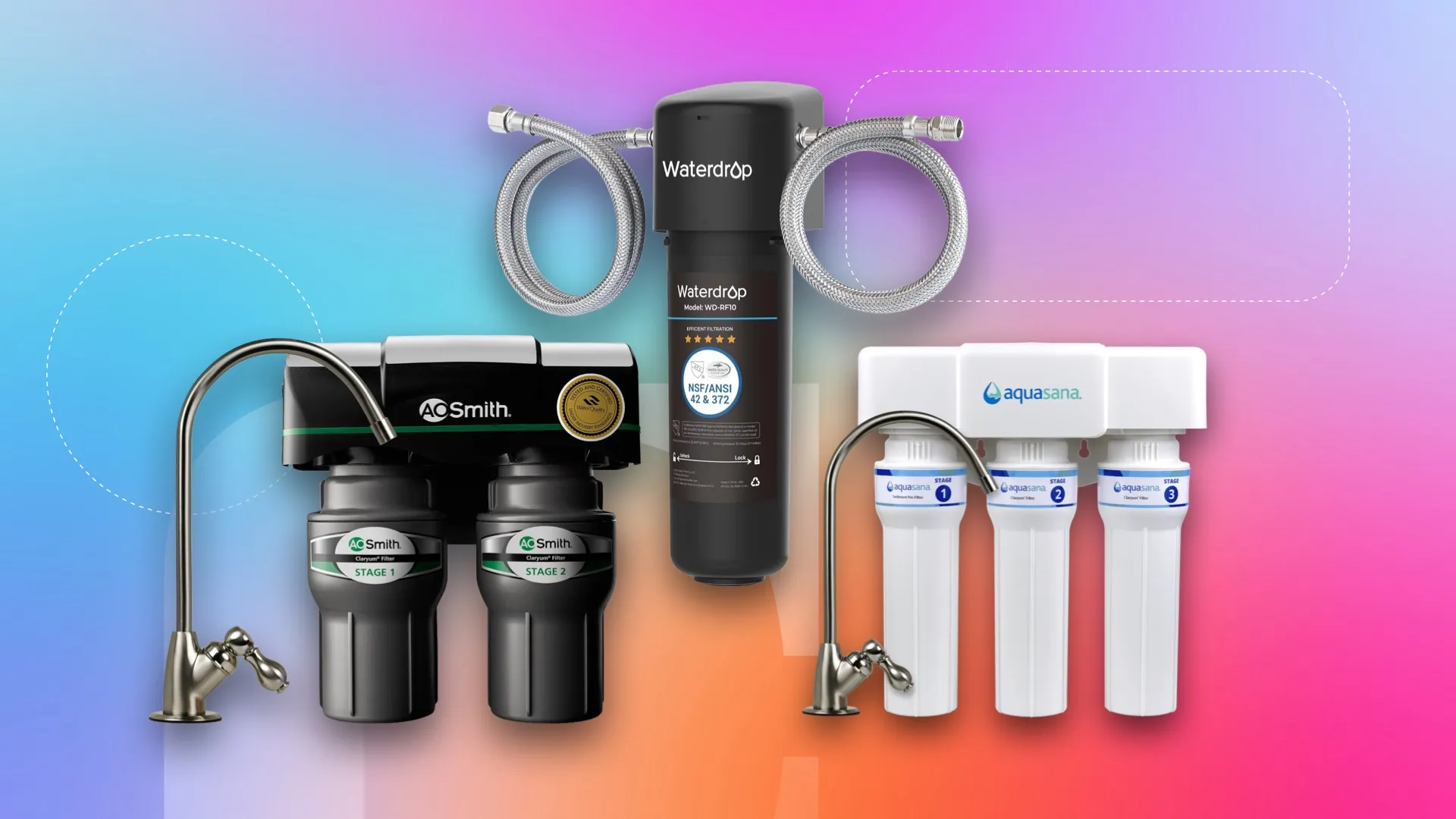
If your water looks murkier or tastes funkier than you’d like, a water filter is an obvious fix. While water filter pitchers are essentially no-commitment, under-sink or whole-house systems are a more permanent, high-capacity option that you rarely have to think about once they’re installed. They filter more powerfully than most pitchers, but they can also cost more.
Our Picks

Bottom Line
The Aquasana Claryum 3-Stage Max Flow is our under-sink water filter pick for most homes on municipal tap water. It’s designed to improve tast…
Pros & Cons
-
Can improve taste and remove health contaminants -
Retains beneficial minerals -
Faucet available in multiple finishes -
Fast flow rate
-
Dedicated faucet can make the installation more difficult

Bottom Line
This two-stage system is a budget-friendly option that matches nearly all of the Claryum 3-Stage Max Flow’s certifications for less than half …
Pros & Cons
-
Can improve taste and remove health contaminants -
Retains beneficial minerals -
Cheaper initial cost
-
Dedicated faucet can make the installation more difficult -
Faucet only available in one finish -
Filter may need to be replaced more frequently

Bottom Line
If you have high-quality pretreated water and you’re simply on the hunt for a water filter to improve taste rather than remove harmful contami…
Pros & Cons
-
Can improve taste -
Affordable at just $40 -
Easy to install
-
Cannot reduce harmful health contaminants

Bottom Line
This under-sink reverse-osmosis system uses three filters and delivers a whopping 10-stage filtration system. Unlike many traditional RO syste…
Pros & Cons
-
The only option on our list that can reduce TDS -
Long filter life options -
Tankless design
-
Expensive -
Outlet required -
Produces wastewater -
Reverse osmosis systems can strip out beneficial minerals in water as well
To help you decide which system is best for your home, we’ve rounded up the top under-sink and whole-house water filter systems.
What is the best overall under-the-sink system?
After reviewing NSF and ANSI certifications for dozens of systems, the Aquasana Claryum 3-Stage Max Flow is the best under-sink water filter for most homes using municipal (city) water because of its extensive third-party testing and ability to clear a wide range of contaminants, including those that pose health risks.
The Aquasana Claryum 3-Stage Max Flow is independently certified for NSF/ANSI Standards 42, 53 and 401. Additional picks for every type of household are below.
Aquasana Claryum 3-Stage Max Flow / Aquasana/CNET
Best overall under-the-sink system
Aquasana Claryum 3-Stage Max Flow
-
Can improve taste and remove health contaminants
-
Retains beneficial minerals
-
Faucet available in multiple finishes
-
Fast flow rate
-
Dedicated faucet can make the installation more difficult
The Aquasana Claryum 3-Stage Max Flow is our under-sink water filter pick for most homes on municipal tap water. It’s designed to improve taste and clarity while removing a range of harmful contaminants. It reduces up to 99.6% of microplastics, PFAS (PFOA and PFOS, long-lasting chemicals), and lead; 99% of VOCs (volatile organic compounds) and asbestos; and 97% of chlorine, while retaining beneficial minerals such as calcium.
Compared to its standard sister unit (the Claryum 3-Stage), the Claryum 3-Stage Max Flow has a 44% faster flow rate (approximately 0.72 to 0.80 gallons per minute), meaning the water pressure is stronger than the standard unit. This unit can purify 800 gallons of water per filter.
It comes with a dedicated faucet that is available in four finishes: brushed nickel, chrome, bronze and matte black, to match your current sink setup.
-
Filter life
-
800 gallons (approximately 6 months)
-
Dedicated faucet included
-
Yes
-
Filter replacement cost
-
$92
-
NSF/ANSI certified to reduce
-
Chlorine and unpleasant odors, select health contaminants, including lead, and select pesticides and medications
A. O. Smith AO-US-200 / Amazon/CNET
Best budget under-the-sink system
A. O. Smith AO-US-200
-
Can improve taste and remove health contaminants
-
Retains beneficial minerals
-
Cheaper initial cost
-
Dedicated faucet can make the installation more difficult
-
Faucet only available in one finish
-
Filter may need to be replaced more frequently
This two-stage system is a budget-friendly option that matches nearly all of the Claryum 3-Stage Max Flow’s certifications for less than half the price.
Like the top model above, the AO-US-200 is independently certified to NSF/ANSI Standards 42, 53 and 401 and can reduce up to 99% of contaminants, such as lead and microplastics. Since it’s a carbon filter, it leaves natural minerals in place and doesn’t reduce total dissolved solids.
The 500-gallon filter has a lower capacity than the 800-gallon option above, but can still last around six months depending on your water usage.
-
Filter life
-
500 Gallons (approximately 6 months)
-
Dedicated faucet included
-
Yes
-
Filter replacement cost
-
$84
-
NSF/ANSI certified to reduce
-
Chlorine and unpleasant odors, select health contaminants, including lead, and select pesticides and medications
Waterdrop WD-10UA / Waterdrop/CNET
Easiest under-the-sink system to install and best for taste
Waterdrop WD-10UA
-
Can improve taste
-
Affordable at just $40
-
Easy to install
-
Cannot reduce harmful health contaminants
If you have high-quality pretreated water and you’re simply on the hunt for a water filter to improve taste rather than remove harmful contaminants, Waterdrop’s under-sink has powerful filtration and won’t bust your budget.
In addition to reducing chlorine, odor, sediment and heavy metals, this is the only under-sink option on our list that doesn’t require an additional faucet to install, making installation simpler. And because it is an in-line faucet, it takes up less space under your sink.
It is NSF/ANSI 42-certified for taste and clarity and NSF/ANSI 372-certified, meaning it is made with lead-free materials.
-
Filter life
-
11,000 gallons (approximately 12 months)
-
Dedicated faucet included
-
No
-
Filter replacement cost
-
$26
-
NSF/ANSI certified to reduce
-
Chlorine and unpleasant odors
Waterdrop G3P800 / Waterdrop/CNET
Best reverse-osmosis system
Waterdrop G3P800
-
The only option on our list that can reduce TDS
-
Long filter life options
-
Tankless design
-
Expensive
-
Outlet required
-
Produces wastewater
-
Reverse osmosis systems can strip out beneficial minerals in water as well
This under-sink reverse-osmosis system uses three filters and delivers a whopping 10-stage filtration system. Unlike many traditional RO systems, it features a tankless design, so it takes up significantly less space under the sink.
It is NSF/ANSI 42, 53 and 58 certified to improve clarity, taste and odor and reduce chlorine, select health contaminants (including lead) and total dissolved solids. It is the only filter on our list certified to reduce dissolved solids. A dedicated smart faucet is included in a silver finish.
Although all reverse osmosis systems produce wastewater, this one has a 3:1 pure-to-drain ratio, making it a more eco-friendly option. However, this is the only under-sink water filter that requires an electrical outlet, so ensure you have one or can install one in order for it to operate.
-
Filter life
-
6 to 24 months, or 800 – 3,200 gallons, depending on which filter you choose
-
Dedicated faucet included
-
Yes
-
Filter replacement cost
-
$30 – $140
-
NSF/ANSI certified to reduce
-
Chlorine and unpleasant odors, select health contaminants (including lead and PFOA/PFOS) and TDS
We based our picks on rigorous NSFI/ANSI testing and certifications
When a filter is certified to NSF/ANSI standards, it means an independent organization, such as NSF International, has verified that the unit meets strict performance standards. According to industry experts we consulted, these are the most rigorous tests for a water filter system, giving them weight over any at-home, third-party or CNET lab testing.
Some of the most common certifications for water filters include:
- NSF/ANSI Standard 42: Covers taste, odor and clarity in your water. These are not health-related but can affect how your water tastes. If a filter has this certification, it can reduce chlorine, chloramine and sediment.
- NSF/ANSI Standard 53: Covers serious health contaminants, such as lead, asbestos, volatile organic compounds and more.
- NSF/ANSI Standard 401: Covers incidental contaminants from prescription drugs, over-the-counter medications, herbicides, pesticides and more.
- NSF/ANSI 58: This is exclusively for reverse osmosis systems. It covers total dissolved solids reduction and specific health contaminants such as lead, arsenic and more.
Under-sink water filters compared
| Aquasana Claryum 3-Stage Max Flow | A. O. Smith AO-US-200 | Waterdrop WD-10UA | Waterdrop G3P800 | |
| System type | Carbon block and multi-stage | 2-stage carbon block | Single-stage carbon block | Reverse osmosis |
| NSF/ANSI certifications | Standards 42, 53, 401 and 372 | Standards 42, 53, and 401 | Standards 42 and 372 | Standards 42, 53, 58, 372 certified. |
| Reduces lead and microplastics? | Yes (up to 99.6% reduction) | Yes (up to 99% reduction) | No (improves taste and odor, and reduces chlorine, sediment and heavy metals) | Yes (up to 99.9% reduction) |
| Flow rate | ~0.72–0.80 gallons per minute | ~0.50 gallons per minute | ~1.5 gallons per minute | ~0.56 gallons per minute |
| Filter life | 800 gallons | 500 gallons | 11,000 gallons | System uses three filters, with lifespans that vary by stage: 6 months or 550 gallons (CF), 12 months or 1,100 gallons (CB) and 24 months or 2,200 gallons (RO). |
| Filter replacement cost | $92 per replacement | $84 per replacement | $26 per replacement | $30 (CF), $30 (CB) and $140 (RO) |
| Dedicated faucet included? | Yes (chrome, brushed nickel, bronze, matte black) | Yes (brushed nickel) | No (hooks directly into existing cold water line) | Yes (silver) |
| Price | $225 | $99 | $40 | $999 |
Best whole-house water filter systems
While under-sink filters target a slew of harmful contaminants in your drinking and cooking water from one dedicated sink, whole-house systems filter all of the water in your home, even what’s in your toilet bowl. Whole-house systems aim to clear heavy sediment, sulfur and chlorine, among other contaminants that can interfere with your plumbing.
However, because they are larger and designed to handle thousands of gallons a month, they cost more and take up more space. And keep in mind, they will not reduce harmful contaminants in your water, such as lead and microplastics.
Best whole-house water filtration system: Aquasana Rhino, $999

If your house has municipal water and you’re concerned about chlorine or other chemicals, the Aquasana Rhino is one of the best options on the market.
It is independently certified to NSF/ANSI Standard 42 to remove up to 97% of chlorine taste and odor. However, it is not certified to remove heavy metal contaminants such as lead.
The system starts at $1,000 with optional add-ons such as a salt-free water conditioner and a prefilter. The main tank lasts for 10 years.
Best budget whole-house system for city water: iSpring WGB32B, $517

iSpring/CNET
This system tackles the same water contaminants as the Aquasana Rhino but costs nearly half as much upfront. However, unlike the unit above, which was independently certified to NSF/ANSI Standard 42, the brand states this iSpring filter is “tested by an independent third party to meet NSF/ANSI standards.”
Like the Aquasana Rhino, this system cannot remove heavy health contaminants from your water.
Best whole-house system for well water: Home Master HMF3SdgFeC, $550

Unlike the two options above, which are ideal for city water, this unit is the best whole-house option for well water. This Home Master unit is a three-stage filter that is said to clear 95% of VOCs, TOC (total organic carbon), herbicides, pesticides, iron, sediment and more.
The second-stage filter, a radial-flow iron-reduction filter, is what makes this ideal for those who use well water. Because well water is often high in iron, this is an important differentiator. The third-stage filter is where chlorine is removed and taste is improved.
Whole-house systems compared
| Aquasana Rhino | iSpring WGB32B | Home Master HMF3SdgFeC | |
| System type | Whole-house multi-stage tank | 3-stage whole-house cartridge system | 3-stage whole-house cartridge system |
| NSF/ANSI certifications | Standards 42 and 61 | N/A | N/A |
| Filter life | Main tank: 1,000,000 gallons, or 10 years Pre-filter: 2–3 months Post-filter: 6 months |
100,000 gallons, or 6 to 12 months | 95,000 to 100,000 gallons, or 6 to 12 months |
| Filter replacement cost | Pre/post filters: ~$37 to $73 per pack Main tank: ~$949 (every 10 years) |
~$115–$126 for full 3-filter pack | ~$235 for full 3-filter set |
| Price | $999 | $517 | $550 |
Water filter buying guide

First, test your water
Before buying a water filter system, test your water at home to see what contaminants may be present. Many states offer this for free through the water department and can send you home with a take-home kit. It’s also important to know whether you get your water from a well or the city, since that will determine what type of water filter you need.
Certifications to look for
Knowing what’s in your water will help you determine which NSF/ANSI certifications to look for.
If you have high chlorine levels or an off taste but no health contaminants, look for NSF/ANSI 42 certification. If you have lead in your water, look for an NSF/ANSI 53 certification. If you have incidental contaminants in your water, such as pesticides, medications and more, look for NSF/ANSI 401 certification. Finally, if you have high TDS, consider reverse osmosis options that are NSF/ANSI 58-certified.
Under-sink vs. whole-house water filters

Whole-house systems will likely require a plumber’s help for installation, but under-sink options can usually be handled on your own. Keep in mind they do take up space under your sink, so make sure you have enough room for the filter. The reverse osmosis system we recommend, the Waterdrop G3P800, requires an electrical outlet.
Another key difference is that under-sink systems can reduce harmful contaminants in your water while whole-house systems do not. Instead, they target build-up and sediment in your water to help your plumbing system stay in tip-top shape. Whole-house systems also usually require more expensive filter replacements.
Yearly filter costs

In addition to the initial cost of the system, factor in the yearly cost of filter replacements and note how many filters each system requires.
For example, the reverse osmosis system on our list, the Waterdrop G3P800, requires three filters that need to be replaced at various times throughout the year, so it costs roughly $160 per year in filter replacement costs.
The Aquasana Claryum 3-Stage Max Flow also uses three filters, but you replace them all at the same time every six months; each filter set costs around $92 at full price. However, if you sign up for auto-delivery, you can get them at a discount of $78.19.
Once the systems are installed in your home, replacing the filters is easy and usually takes less than 5 minutes, no matter which system you choose.
Read more: I Tested the Best Showerhead Filters You Can Buy in 2026, Here’s What I Discovered
Popular filter types
Reverse osmosis: This filter type uses a multistage filtration system and is one of the most thorough methods for purifying your water. It is also the main type of residential filter that can meaningfully reduce TDS. However, because it is such a powerful filtration system, it can also strip your water of beneficial minerals, such as calcium, that other types of filtration systems, such as carbon block, can leave behind.
Multi-stage and carbon block: A multi-stage filter passes water through multiple filters to ensure thorough purification. The Aquasana Claryum 3-Stage Max Flow and A. O. Smith AO-US-200 are both multistage systems that use carbon block filters, dense cylinder filters designed to capture contaminants.
Inline filters: An inline filter connects directly to your already-existing cold-water line and doesn’t require a dedicated water filter faucet or in-depth installation. They are often more affordable than multistage options but typically do not reduce harmful contaminants, such as lead. On our list, this includes the Waterdrop WD-10UA.
Ultrafiltration: An ultrafiltration system is best for removing physical particles in your water rather than dissolved contaminants.
Renting or can’t install? Try a countertop or pitcher filter
If you’re a renter or don’t want to install an under-sink or whole-house system, a pitcher filter may be a better option, although it usually can’t remove as many contaminants as under-sink options.

Here are the best countertop water filters of 2026 and the best water filter pitchers of 2026.
How we chose the water filters on this list
When choosing water filters for this list, we considered certifications and price. We also wanted to offer a range of options for different needs, from removing lead to simply improving your tap water taste.
Under-sink water filter FAQs
Is an under-sink water filter worth it?
If you have concerns about contaminants in your water or just don’t like the taste, then yes, they are definitely worth it, and they’re much more affordable than whole-house systems.
Do under-sink water filters remove lead?
This depends entirely on the certifications. If they are certified to NSF/ANSI 53 or 58, then yes, they can significantly reduce lead. On this list, that includes the Aquasana Claryum 3-Stage Max Flow, the A. O. Smith AO-US-200 and the Waterdrop G3P800.
How often should you change an under-sink water filter?
This depends on the specific filter, but the options on our list typically last for six or more months.
Is it hard to install an under-sink water filter?
Unlike whole-house systems, under-sink systems are usually DIY-friendly, but depending on the model, you will still need a few tools. The main hurdle for the Aquasana Claryum 3-Stage Max Flow and the A. O. Smith AO-US-200 is that you need an additional hole for the faucet.
Do whole-house filters soften hard water?
No. A water softener is needed.

See full bio